That sounds straightforward. Yet many businesses receive monthly reports filled with rankings, traffic charts, and lists of activities without a clear explanation of what their agency accomplished.
The problem isn't necessarily a lack of work. It's often a lack of accountability.
This guide explains the seven core SEO agency deliverables, how to verify each one, what to expect during the first 90 days, and how to evaluate your agency's work without becoming an SEO expert yourself.
01SEO Activities vs Deliverables vs Results: What's the Difference?#
Before evaluating an agency, understand three terms that are often used interchangeably.
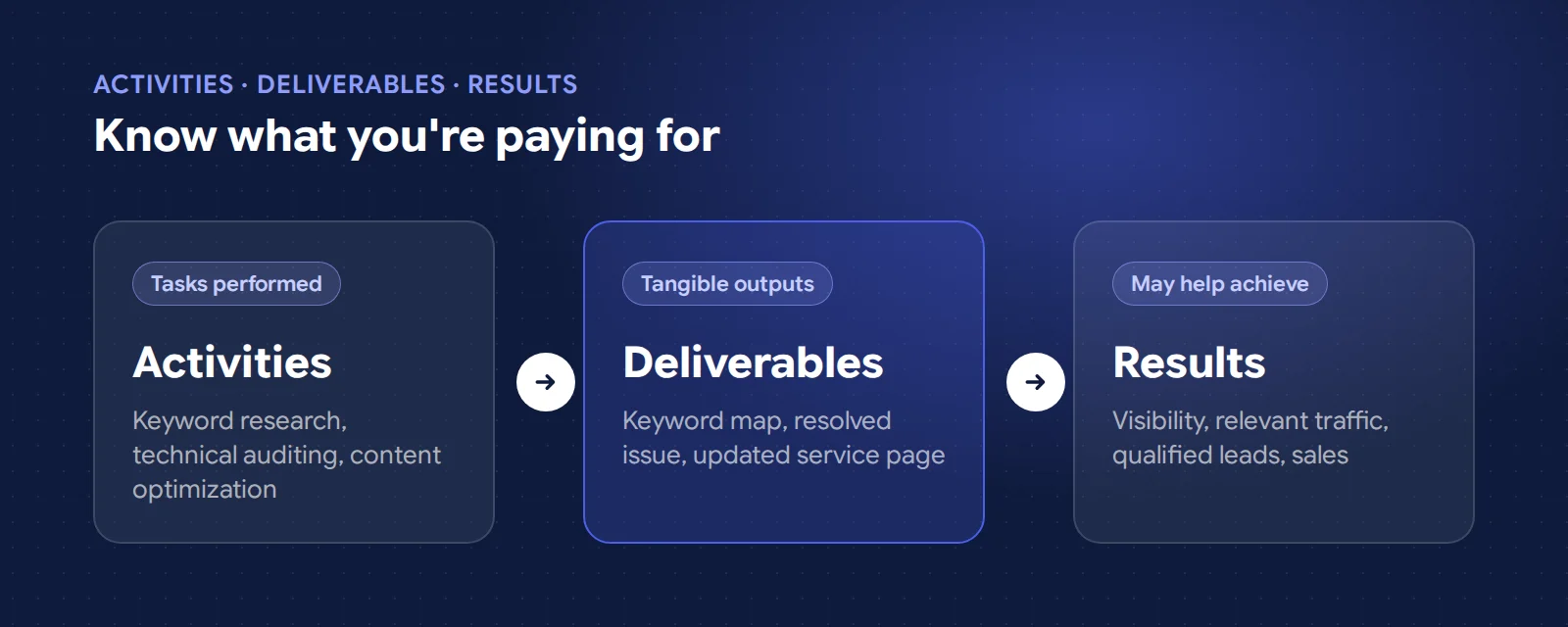
SEO activities are tasks being performed, such as keyword research, technical auditing, or content optimization.
SEO deliverables are the tangible outputs of those tasks, such as a keyword map, resolved technical issue, updated service page, or completed performance report.
SEO results are the changes those deliverables may help achieve, including improved visibility, relevant organic traffic, qualified leads, and sales.
| SEO activity | Actual deliverable | Business value |
|---|---|---|
| Keyword research | Prioritized keyword-to-page map | Focus on relevant customer searches |
| Technical audit | Documented fixes and verification | Fewer technical barriers to organic visibility |
| On-page optimization | Updated URLs with recorded changes | More relevant commercial landing pages |
| Content strategy | Published or improved content | Better coverage of customer needs |
| Internal linking | Relevant links added to specific pages | Better discovery and navigation |
| SEO reporting | Performance analysis and next actions | Better business decisions |
An agency may complete its agreed deliverables without immediately improving rankings. Search performance depends on competition, implementation, demand, and factors outside the agency's control.
However, that doesn't mean deliverables should be disconnected from results. Every important activity should have a clear business reason.
02The Seven Core SEO Agency Deliverables#
A comprehensive SEO engagement generally involves seven areas. Not all require equal attention every month, and some may be excluded from a specialist or consulting contract.
1. SEO Strategy and Keyword Mapping
A proper SEO strategy starts with understanding your business, customers, competitors, and current website performance.
Your agency should identify which searches matter, which pages should target them, and what needs to happen first.
Expected deliverables:
- Website and search visibility assessment
- Competitor and search intent research
- Keyword research organized by business relevance
- Keyword-to-page mapping
- Identification of missing commercial pages
- Prioritized SEO roadmap
- Agreed performance goals
Example:
Imagine a freight forwarding company wants more international shipping inquiries.
An agency researches hundreds of logistics keywords. That's an activity.
A useful deliverable is a keyword map showing which existing service pages should be improved, which new pages might be needed, and which informational topics can support commercial pages.
The agency should validate page decisions against actual search results rather than creating a separate page for every keyword variation.
How to verify it: Ask which pages are being prioritized, what customer searches they target, and why those opportunities matter to your business.
2. Technical SEO Improvements
Technical SEO helps search engines access, crawl, render, and understand important website pages.
An audit can reveal problems, but the audit itself doesn't resolve them.
Expected deliverables:
- Crawlability and indexability analysis
- XML sitemap and robots.txt review
- Canonical and redirect checks
- Broken-link and duplicate URL investigation
- Internal crawl-path improvements
- JavaScript rendering assessment when relevant
- Structured data review
- Core Web Vitals recommendations
- Implemented fixes or developer-ready instructions
Example:
Suppose an ecommerce website has important category pages that Google isn't indexing.
A weak monthly report says:
Found indexing issues.
A stronger report explains:
| Item | Evidence |
|---|---|
| Problem | Important category URLs excluded from Google's index |
| Investigation | Canonical signals, internal links, content, rendering, and indexing data reviewed |
| Action | Confirmed issues corrected or assigned to developers |
| Verification | Affected URLs rechecked after implementation |
| Status | Resolved, pending, or awaiting Google recrawl |
Fixing a technical issue doesn't guarantee that Google will immediately index a page. The agency should report the actual status rather than claim success prematurely.
How to verify it: Request the affected URLs, change records, implementation status, and follow-up checks.
3. On-Page SEO Optimization
On-page SEO improves how individual pages satisfy search intent and communicate their relevance.
It goes beyond inserting keywords into headings.
Expected deliverables:
- Search intent analysis
- Title and meta description improvements
- Heading and page structure updates
- Service or product content revisions
- Relevant internal links
- Content consolidation where necessary
- Improved conversion paths
- Before-and-after documentation
Example:
A commercial cleaning company's service page receives relevant search impressions but few inquiries.
The agency investigates whether the problem is related to rankings, search snippets, page content, trust signals, or the contact process.
The deliverable might include an improved page structure, clearer service information, stronger supporting evidence, and a more accessible inquiry form.
How to verify it: Ask for the exact URLs changed, what was improved, and why.
A report saying "optimized five pages" isn't as useful as five documented URLs with specific improvements.
4. Content Creation and Optimization
Publishing articles is one possible SEO deliverable. It isn't the goal by itself.
Your agency should create or improve content that addresses genuine customer needs and supports relevant business pages.
Expected deliverables:
- Content gap analysis
- Search intent research
- Content briefs
- New service, category, or supporting pages
- Existing content improvements
- Editorial and factual review
- Contextual internal links
- Performance evaluation
Example:
An online office furniture retailer publishes four general productivity articles each month.
Those articles may generate traffic, but they might contribute little to product discovery or sales.
A more valuable approach could involve improving important furniture categories, answering buyer comparison questions, and creating relevant supporting guides.
The right decision depends on actual search demand and the website's current gaps.
How to verify it: Ask what search intent each piece serves, which page it supports, and how its performance will be evaluated.
A content calendar should explain why something deserves to be published, not just when it will be published.
5. Internal Linking and Authority Building
Internal links help visitors and search engines discover related pages.
Off-site work may involve digital PR, relevant editorial mentions, partnerships, and legitimate link acquisition.
These are different activities and should be reported separately.
Expected deliverables:
- Internal linking assessment
- Relevant contextual links added to specific pages
- Orphan-page and navigation improvements
- Backlink profile analysis
- Relevant outreach opportunities
- Earned placement records, if included
- Transparent reporting of third-party costs
Example:
An ecommerce SEO guide explains why product category pages fail to rank.
A contextual link to the agency's ecommerce SEO service page may help readers who need implementation support.
For off-site work, the agency should identify earned placements and explain their relevance.
A report that says "20 backlinks built" without identifying the sources gives you little basis for evaluation.
How to verify it: Check the actual internal links and request external placement URLs.
Link building should also respect Google's spam policies. Paid or sponsored links require appropriate qualification.
6. Analytics, Conversion Tracking, and Reporting
SEO reporting should explain what happened, what work was completed, and what decisions follow from the evidence.
Traffic alone doesn't measure business success.
A B2B business may care most about qualified inquiries. An ecommerce company may prioritize organic revenue and product-category performance.
Expected deliverables:
- Search Console performance analysis
- Analytics and conversion tracking checks
- Important landing-page performance
- Relevant keyword visibility monitoring
- Completed-work records
- Technical issue status
- Lead or sales analysis where tracking allows
- Next-month recommendations
Example: A useful monthly SEO report
The figures below are fictional examples for illustration, not actual client results.
| Reporting area | Example |
|---|---|
| Business goal | Increase qualified inquiries for commercial services |
| Completed work | Updated two service pages, fixed internal redirects, improved contextual links |
| Verification | URLs and implementation records supplied |
| Search performance | Relevant service-page clicks increased from 120 to 145 |
| Conversions | Tracked organic inquiries increased from 8 to 10 |
| Limitation | Lead qualification data not yet connected |
| Pending work | One technical fix awaiting developer approval |
| Next priority | Improve a service page with relevant impressions but limited clicks |
Notice that the report doesn't automatically attribute every improvement to the completed work.
It documents what happened and explains what can reasonably be concluded.
How to verify it: Review the affected URLs and relevant analytics data. Ask your agency to distinguish completed work, observed performance, business outcomes, and unresolved issues.
Should AI Overviews and ChatGPT visibility be included?
If AEO or GEO is part of your agreement, ask for a defined scope.
Possible deliverables include improving content clarity, strengthening factual evidence, ensuring important information is accessible, improving relevant internal links, and monitoring AI-search visibility where reliable data is available.
Google's generative AI search guidance emphasizes useful, original content and established SEO practices rather than special tricks.
An agency shouldn't guarantee citations in Google AI Overviews or ChatGPT.
7. Ongoing Optimization and Prioritization
SEO isn't a fixed monthly checklist.
Competitors change, search demand shifts, technical problems emerge, and performance data reveals new opportunities.
Expected deliverables:
- Review of performance against business goals
- Investigation of important changes
- Reassessment of unresolved issues
- Updates to underperforming content
- Revised priorities
- Documented decisions and next actions
Example:
Your agency plans to publish three articles next month.
New Search Console data shows that an existing service page already receives impressions for relevant commercial searches but attracts few clicks.
Improving that page may be more valuable than publishing another article.
A good agency should be able to explain why the priorities changed.
How to verify it: Ask what the agency learned this month and how those findings affected the next plan.
03What Should an SEO Agency Deliver in the First 90 Days?#
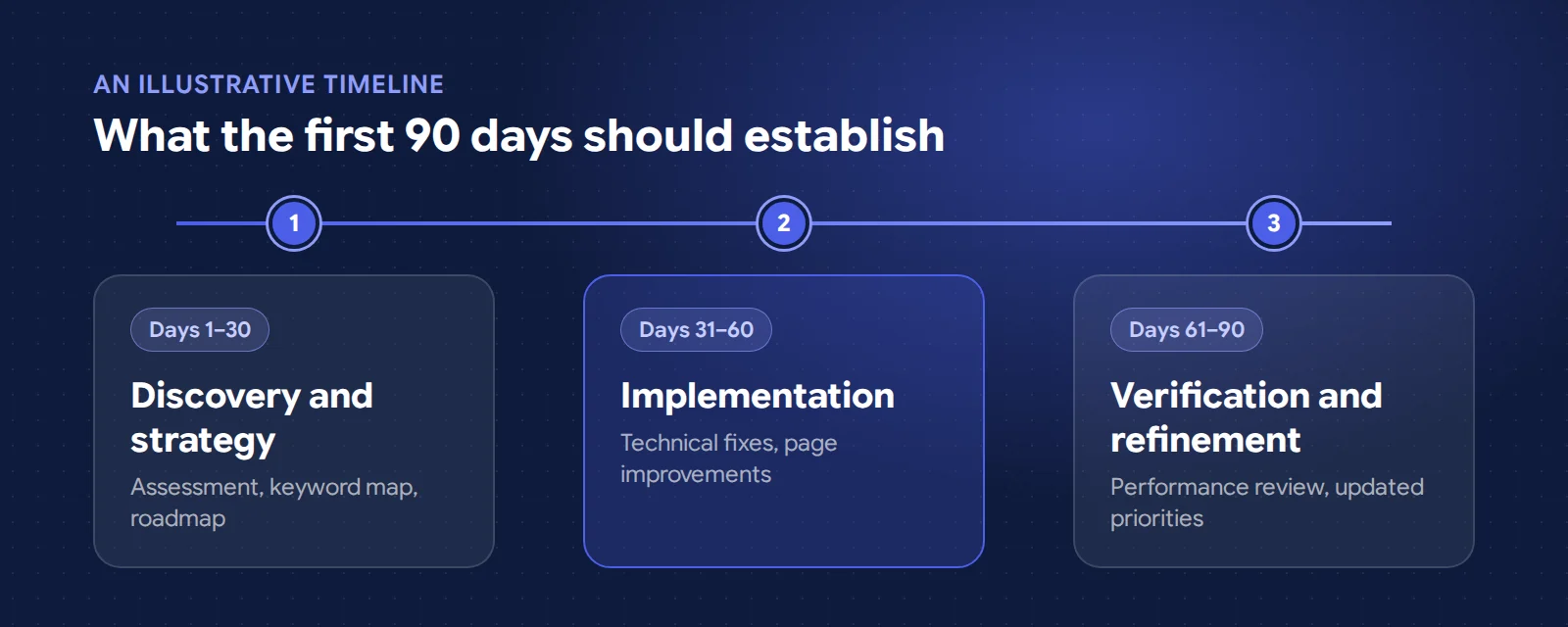
The first three months should establish a baseline, begin meaningful implementation, and create a repeatable measurement process.
| Period | Main priority | Typical deliverables |
|---|---|---|
| Days 1–30 | Discovery and strategy | Website assessment, keyword mapping, tracking review, prioritized roadmap |
| Days 31–60 | Implementation | Important technical fixes, commercial page improvements, content and linking work |
| Days 61–90 | Verification and refinement | Performance review, implementation checks, updated priorities |
This is an illustrative timeline, not a guarantee.
A website migration, serious indexing problem, or complex development environment may require a different sequence.
During the first 90 days, evaluate whether the agency understands the business, completes agreed work, communicates blockers, and makes defensible decisions.
04Who Should Implement SEO Recommendations?#
This is one of the most important details to clarify before starting an SEO engagement.
Some agencies implement changes directly. Others provide recommendations for your developers and content team.
Neither model is automatically wrong.
The problem begins when responsibilities are unclear.
For each important task, establish:
- Who investigates the issue?
- Who proposes the solution?
- Who approves the change?
- Who implements it?
- Who verifies completion?
For example, if your agency recommends fixing canonical tags but your development team hasn't deployed the changes, the task should be reported as pending implementation.
It shouldn't be counted as a completed technical fix.
05Do SEO Deliverables Differ by Business Type?#
Yes. Different websites require different priorities.
| Business type | Likely SEO priorities |
|---|---|
| Local service business | Service pages, location relevance, Google Business Profile, inquiry tracking |
| Ecommerce store | Product and category pages, indexing, internal links, organic revenue |
| B2B company | Commercial service pages, industry content, credibility, qualified leads |
| International business | Market-specific keyword research, localization, international SEO |
| Enterprise website | Technical scalability, development coordination, site architecture |
A local business with a small website shouldn't automatically receive the same monthly package as an ecommerce company managing thousands of URLs.
The scope should reflect the actual work needed.
06The SEO Deliverables Scorecard: How to Evaluate Your Agency#
Instead of judging an agency only by rankings or the number of completed tasks, use this practical scorecard.
Give each category a score from 0 to 2.
- 0: Missing or unclear
- 1: Partially addressed
- 2: Clear, documented, and verifiable
| Evaluation category | What to check | Maximum |
|---|---|---|
| Strategy | Priorities connect to business goals | 2 |
| Technical work | Issues have evidence, owners, and status | 2 |
| On-page improvements | Actual page changes are documented | 2 |
| Content | Every major piece has a defined purpose | 2 |
| Linking and authority | Relevant work and sources are transparent | 2 |
| Reporting | Performance and completed work are distinguishable | 2 |
| Next priorities | Future actions are evidence-based | 2 |
| Total | 14 |
How to interpret your score
12–14: Strong documentation and accountability across most areas.
8–11: Some useful processes are in place, but several areas need clarification.
0–7: Review the agreement and request clearer evidence before drawing conclusions.
This is an informal evaluation framework, not a scientifically validated rating system.
Only score categories that are relevant to your contract. If a service is legitimately excluded, mark it as not applicable and calculate your score against the remaining maximum.
A high score doesn't guarantee SEO growth. It indicates that the agency's work is easier to evaluate.
07Five Warning Signs Your SEO Agency Isn't Delivering Enough#
1. Reports show activity but no completed changes
Keyword research, audits, and monitoring are useful. But ongoing work should also produce outputs appropriate to the agreement.
2. The same issues appear every month
Repeated technical problems aren't always the agency's fault. However, there should be a clear explanation of why they're unresolved.
3. Business outcomes are ignored
If your goal is qualified leads, reports should go beyond total organic visits whenever reliable conversion data is available.
4. Link-building sources are unclear
You should know where external placements came from and whether any third-party costs were involved.
5. The roadmap never changes
A strategy that ignores new evidence can become a routine of low-value activities.
These warning signs justify questions and closer review. They don't automatically prove poor performance.
08What Should You Ask Your SEO Agency Every Month?#
You don't need to understand every technical SEO detail.
Start with these questions:
- 1
What were the most important deliverables completed?
- 2
Which pages or business goals did they support?
- 3
Where can I verify the changes?
- 4
What improved, declined, or remained unchanged?
- 5
Are we attracting relevant visitors and inquiries?
- 6
Which issues are still unresolved, and who owns them?
- 7
What should we prioritize next, and why?
Clear answers help you evaluate the engagement without relying on impressive-looking dashboards.
09How Much SEO Work Should Be Included in a Monthly Package?#
There's no universal number of articles, backlinks, or optimized pages every agency must deliver.
A small service website and a large ecommerce platform may require very different workloads.
Instead of comparing packages only by task count, compare the work required, implementation responsibilities, and expected business value.
For a detailed breakdown of budgets and pricing models, read our guide to SEO services costs in 2026.
10Final Thoughts#
An SEO agency should deliver more than traffic charts and a monthly list of activities.
You should receive a clear strategy, relevant improvements, evidence of completed work, transparent reporting, and priorities that reflect what your business actually needs.
Not every month will produce higher rankings or more leads. But every reporting period should help you understand what was accomplished, what remains unresolved, and what happens next.
The question isn't simply, "What did my SEO agency do this month?" It's, "What changed, how can we verify it, and why does it matter?"
If you're looking for a structured approach to organic growth, explore FluxSEO Pro's SEO services to see how we approach search strategy, implementation, and performance measurement.
FAQFrequently asked questions
An SEO agency should provide evidence of completed work, relevant performance analysis, outstanding issues, and next priorities. Specific deliverables depend on the contract and may include technical fixes, page improvements, content, internal linking, and authority work.
Review the quality and relevance of completed work, implementation evidence, reporting transparency, and progress toward agreed business goals. Rankings alone don't provide a complete evaluation.
No. Agencies can commit to agreed work and professional standards, but they cannot guarantee specific organic rankings.
It depends on the agreement. Some agencies implement changes directly, while others provide recommendations for internal development teams. Responsibilities should be documented.
There is no universally correct number. Content production should reflect search demand, business priorities, and existing content gaps. Updating an important page may be more valuable than publishing several new articles.
It should cover completed deliverables, important search performance changes, relevant conversions, unresolved issues, and next priorities.
Not always. AI-search optimization may be included in a broader SEO service or offered separately. Ask which activities are included, how they will be verified, and what outcomes can realistically be measured.