

SEO pricing can range from a few hundred dollars per month to five figures. That range isn't particularly useful when you're trying to decide what your business should spend.
The better question is: what SEO work does your business actually need to compete?
A local company trying to rank in one city has a very different workload from an ecommerce store with thousands of URLs or a SaaS company competing internationally.
Those figures are useful benchmarks, not a price your business should automatically expect to pay.
Your actual SEO cost depends on your competition, website size, technical condition, target market, content requirements, authority gap and how much work is required to reach commercially meaningful search visibility.
01Why does SEO pricing vary so much?#
Two companies can ask for "SEO services" and need completely different amounts of work.
Consider a local accounting firm with a 25-page website. Its biggest opportunities might be improving service pages, strengthening local visibility, fixing technical issues and building authority in one geographic market.
Now compare that with an ecommerce business carrying 15,000 products across hundreds of categories.
That project could involve crawl management, faceted navigation, category architecture, duplicate product content, internal linking, structured data, content development and ongoing technical work.
Both businesses need SEO.
They don't need the same SEO.
Several factors determine how much work a campaign requires.
Competition
Ranking against a handful of local businesses is different from competing against established national or international brands.
The stronger the search results already are, the more work may be required across content, technical SEO, authority and brand visibility.
Website size
A 30-page service website and a 30,000-URL ecommerce store don't require the same level of analysis.
Larger websites often introduce additional challenges around crawling, indexation, duplicate pages, architecture, internal linking and content management.
Current website condition
A technically healthy website needs a different scope from one dealing with migration problems, broken internal links, poor architecture, duplicate content or years of neglected SEO.
Sometimes the fastest path to growth isn't publishing more content. It's fixing what is already preventing existing pages from performing.
Target market
Competing in one city, across an entire country or across several international markets requires different strategies.
International campaigns may also introduce language, localization, hreflang, regional search behaviour and market-specific competition.
Content requirements
Some companies already have experienced writers and subject-matter experts.
Others need research, content strategy, briefs, writing, editing, publishing and ongoing optimization.
Those are very different scopes.
Authority gap
If the businesses ranking above you have significantly stronger backlink profiles, brand recognition and third-party mentions, improving on-page copy alone may not close the gap.
Business model
Local businesses, SaaS companies, manufacturers and ecommerce stores share SEO fundamentals, but execution can look very different.
That's why comparing SEO providers purely by their monthly fee rarely tells you which option offers better value.
02What are the common SEO pricing models?#
SEO is usually sold through a monthly retainer, project fee, hourly rate or consulting arrangement.
| Pricing model | How it works | Often suitable for |
|---|---|---|
| Monthly retainer | Ongoing SEO work for a recurring monthly fee | Businesses pursuing sustained organic growth |
| Project-based | Fixed scope, timeline and deliverables | Audits, migrations and defined SEO projects |
| Hourly | Payment based on time used | Smaller tasks and specialist support |
| Consulting | Strategic direction without full execution | Companies with internal marketing or development teams |
Monthly retainers are particularly common. In Ahrefs' SEO pricing survey, 78.2% of providers offered monthly retainers, while project and hourly pricing were also widely used.
But a retainer isn't automatically the right choice.
If you're preparing for a website migration, diagnosing a traffic decline or trying to solve one specific technical problem, a defined project may make more sense.
If you already have developers, writers and marketers but need senior search direction, working with an SEO consultant may be more appropriate than outsourcing your entire SEO operation.
The pricing model should follow the problem, not the other way around.
03What should monthly SEO services actually include?#
This is where comparing SEO proposals becomes difficult.
Two agencies can both quote:
SEO services: $2,000/month
while offering completely different levels of strategy and execution.
Instead of looking only at the monthly figure, understand what is actually being done and why.
Depending on the website, an ongoing SEO engagement can include the following.
Technical SEO
Crawling, indexation, canonicalization, site architecture, Core Web Vitals, JavaScript rendering, structured data and other technical issues that can affect search performance.
Search and content strategy
Keyword research alone isn't enough.
Search queries need to be connected to search intent, business value and the correct landing pages.
Otherwise, a website can gain rankings and traffic without attracting people who are likely to become customers.
On-page optimization
Titles, headings, page copy, internal links, entities and information architecture should make pages clearer to both users and search engines.
The objective isn't to repeat a keyword a certain number of times. It's to create the strongest page for the searcher's actual need.
Content development
New content should address an identifiable search, customer or commercial gap.
Publishing four arbitrary blog posts every month because they're included in an SEO package isn't a content strategy.
Authority building
Depending on the competitive landscape, this can include digital PR, relevant link acquisition, brand mentions and other activities designed to strengthen authority.
Measurement
Rankings and traffic matter, but they aren't the final business outcome.
Good SEO measurement should eventually connect organic visibility with qualified traffic, enquiries, sales and revenue.
Google describes professional SEO work as potentially including site-structure reviews, technical development advice, content development, keyword research and expertise in particular markets and geographies. Its current documentation also explicitly includes optimization for generative AI among services an SEO may provide.
At FluxSEO Pro, our SEO services follow the same basic principle: identify what's limiting search growth first, then determine the work required to address it.
04Cheap SEO and efficient SEO aren't the same thing#
Low-cost SEO isn't automatically bad.
A small website operating in a low-competition market may genuinely require less work.
The problem starts when a low price is possible only because SEO has been reduced to a standard package such as:
10 keywords
4 blog posts
50 backlinks
1 monthly report
That list tells you what will be produced.
It doesn't tell you why those activities should improve the business.
If a website has serious crawling and indexation problems, publishing more articles may achieve very little.
If ecommerce category architecture is preventing important pages from ranking, another batch of links pointing to the homepage doesn't necessarily solve the problem.
And if organic traffic is already increasing but enquiries aren't, chasing more informational keywords may simply produce more visitors with the same conversion problem.
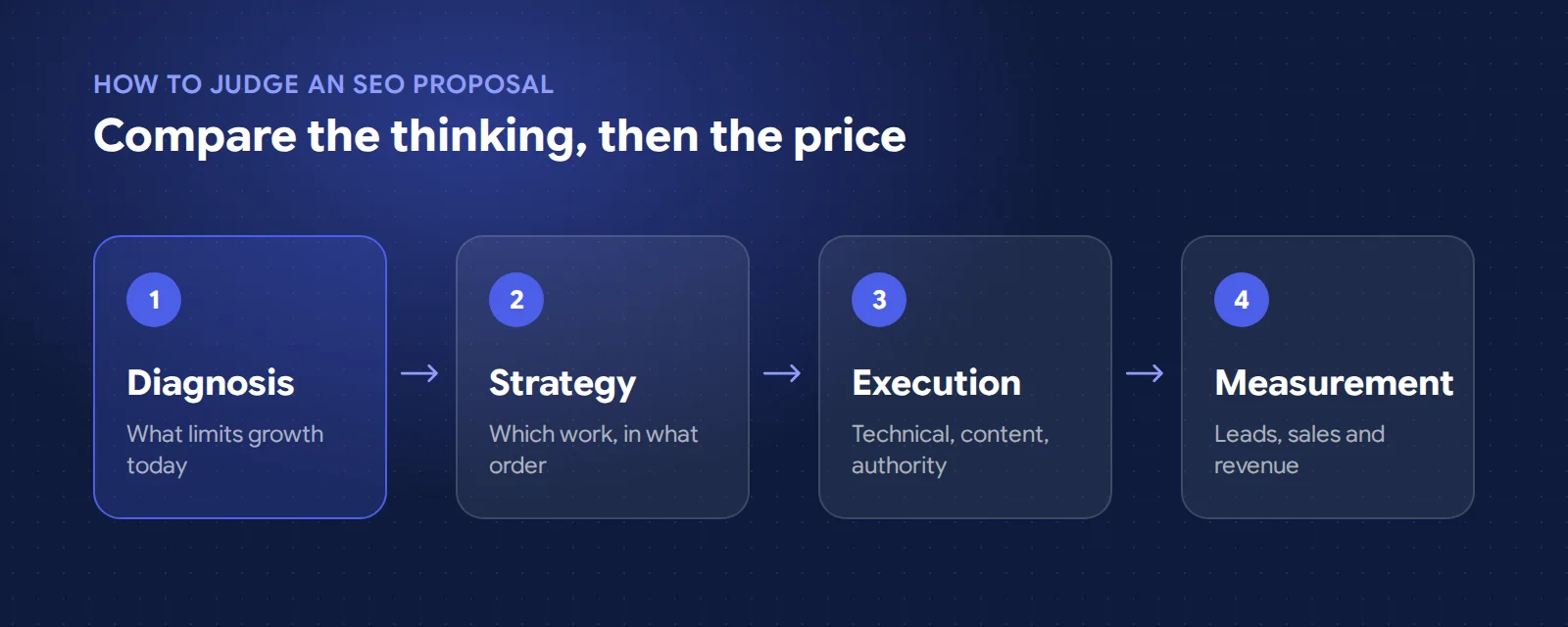
Before comparing prices, compare the thinking behind the work:
Diagnosis → Strategy → Execution → Measurement
That's more useful than comparing how many deliverables two packages contain.
05How much should your business spend on SEO?#
There isn't one responsible number that applies to every business.
Instead, start with four questions.
1. What is an organic customer worth?
If one new customer generates $150, your acquisition economics are very different from a B2B company where a customer may be worth $50,000 over the relationship.
That doesn't mean you should simply spend more whenever customer value is higher.
It means your SEO investment should be evaluated against the commercial opportunity it is trying to capture.
2. How competitive are the search results?
Look at the websites currently ranking for the commercial searches you want.
Consider their:
- content quality
- authority
- brand strength
- backlinks and mentions
- topical coverage
- landing-page quality
- overall SERP presence
You're not paying Google for organic rankings.
You're investing in making your website a stronger search result than the alternatives already competing for that visibility.
Google states that advertising with Google doesn't affect a website's presence in organic search results, and that it doesn't accept payment to include or rank sites organically.
3. How far behind is the website?
A website already sitting around positions 8–15 for valuable commercial terms presents a different opportunity from one with major technical problems and almost no relevant search visibility.
Before setting the budget, understand the gap.
What already works?
What is underperforming?
What needs to be created?
And what is realistically standing between the website and stronger commercial visibility?
4. What capabilities already exist internally?
Do you already have:
- developers?
- writers?
- designers?
- digital PR support?
- analytics expertise?
- subject-matter experts?
An SEO provider filling all of those gaps will naturally require a different scope from a consultant advising an established internal team.
Your SEO budget should follow the opportunity and resource gap, not an arbitrary package price.
06SEO agency vs freelancer vs consultant: why do prices differ?#
You're not only paying for someone's time.
You're paying for an operating model.
A freelancer can be an excellent choice when the scope is relatively narrow and one person's expertise covers most of the work.
An SEO consultant can make sense when your company already has the resources to execute but needs strategy, diagnosis, oversight or specialist expertise.
An agency becomes more useful when the campaign requires several disciplines at the same time: technical SEO, content, digital PR, analytics, development and project management, for example.
The pricing data reflects some of that difference.
In Ahrefs' survey of 439 SEO providers, agencies reported an average monthly retainer of approximately $3,209, compared with approximately $1,348 for freelancers.
Those figures describe the providers surveyed. They aren't recommendations for what your business should spend.
The cheapest operating model isn't automatically the wrong one.
And the most expensive isn't automatically the best.
A better question is:
Who has the right capabilities to solve our problem without making us pay for work we don't need?
07What should you ask before agreeing to an SEO price?#
Don't start with:
"How many backlinks will I get?"
Start with questions that reveal how the provider thinks.
- 1
What is currently limiting our organic growth?
- 2
What would you prioritize during the first 90 days?
- 3
What work is included, and what isn't?
- 4
Who will actually work on our account?
- 5
How will SEO connect to leads, sales or revenue?
- 6
What will require involvement from our internal team?
- 7
How will progress be measured?
- 8
What happens if the original strategy isn't producing the expected signals?
Google recommends interviewing prospective SEOs, checking business references and carefully reviewing proposed SEO audits. Its hiring guidance also advises businesses to be cautious when a provider promises guaranteed first-position rankings.
If you're currently comparing providers, use our detailed guide to the questions you should ask before hiring an SEO agency.
Related guideQuestions to Ask Before Hiring an SEO AgencyThat guide covers methodology, communication, reporting, expertise, conflicts of interest and the warning signs worth checking before signing a contract.
08When does paying more for SEO make sense?#
A higher SEO budget can make sense when the additional investment corresponds to additional work that the business genuinely needs.
For example:
- the site contains thousands of important URLs;
- several countries or languages are being targeted;
- technical problems require ongoing developer involvement;
- competitors have a substantial authority advantage;
- the business needs original expert content at scale;
- digital PR or authority building is necessary;
- several SEO disciplines need to run simultaneously;
- organic search has significant revenue potential.
But paying more doesn't automatically produce better SEO.
A larger retainer filled with unnecessary deliverables is still wasted budget.
The important question is whether the additional investment addresses a real constraint on growth.
09When can a smaller SEO budget be enough?#
Not every business needs a large agency retainer.
A smaller budget may be reasonable when:
- the website is small;
- the target market is geographically narrow;
- competition is relatively limited;
- the technical foundation is already healthy;
- the company can create content internally;
- development support already exists;
- the immediate problem has a clearly defined scope.
For some businesses, a focused audit plus internal execution can be more sensible than paying for a full-service retainer.
For others, the opportunity is large enough that piecemeal SEO creates more delay than savings.
This is why the scope should be decided after understanding the site, not by forcing every business into Bronze, Silver and Gold packages.
10So, what is a reasonable SEO budget?#
A reasonable SEO budget gives the people responsible for search enough resources to address the problems standing between your website and commercially valuable visibility, without making you pay for work the website doesn't need.
That means:
$500 per month can make sense for one business and be completely inadequate for another.
Likewise:
$5,000 per month can be justified for one company and wasteful for another.
The number alone doesn't tell you much.
Scope is what makes the price meaningful.
Before comparing SEO packages, answer four questions:
Where are we now?
Where is the search opportunity?
What's preventing us from capturing it?
What work will close that gap?
Once those questions have credible answers, pricing becomes much easier to evaluate.
FAQFrequently asked questions
SEO services commonly range from a few hundred dollars to several thousand dollars per month. In Ahrefs' survey of 439 SEO providers, 63% charged between $500 and $5,000 per month, while the overall average was $2,917. Your actual cost will depend on competition, website size, technical requirements, target market, content needs and the type of provider you hire.
It can be. A small website operating in a low-competition local market may require a relatively limited SEO scope. The same budget is much less likely to support comprehensive SEO for a large ecommerce store or a company competing nationally across difficult commercial searches. The useful question isn't whether $500 is universally enough. It's whether the work available within that budget is enough to address your particular search opportunity.
An agency may provide access to several specialists across technical SEO, content, digital PR, development, analytics and account management, while a freelancer generally operates with a leaner model. Ahrefs' pricing survey found agencies charging more on average than freelancers, although averages don't tell you which option is right for a particular business. Choose based on the expertise and resources your project actually requires.
There is no universal contract length that guarantees SEO results. The timeline depends on your starting position, competition, website condition, resources and the amount of work required. A credible provider should explain what it plans to change, what progress it expects to measure and what assumptions the strategy depends on rather than treating a specific ranking position by a fixed date as guaranteed.
Sometimes a one-time project is enough for a specific need, such as an audit, migration review or strategic consultation. Businesses competing continuously for valuable search demand usually require ongoing work because websites change, competitors improve, new opportunities appear and content or technical issues develop over time.
It can be when organic search reaches people who are commercially valuable to the business and there is a realistic opportunity to compete. SEO becomes harder to justify when a business hasn't identified meaningful search demand, cannot convert relevant visitors, or is paying for activity that isn't connected to business outcomes. The decision should be based on opportunity, expected customer value, competition and execution requirements, not traffic potential alone.
Price matters, but it shouldn't be evaluated in isolation. Compare the provider's diagnosis, proposed strategy, relevant experience, deliverables, communication, measurement approach and ability to connect SEO work with business outcomes. A cheaper proposal that doesn't address the real problem can ultimately cost more than a properly scoped campaign.